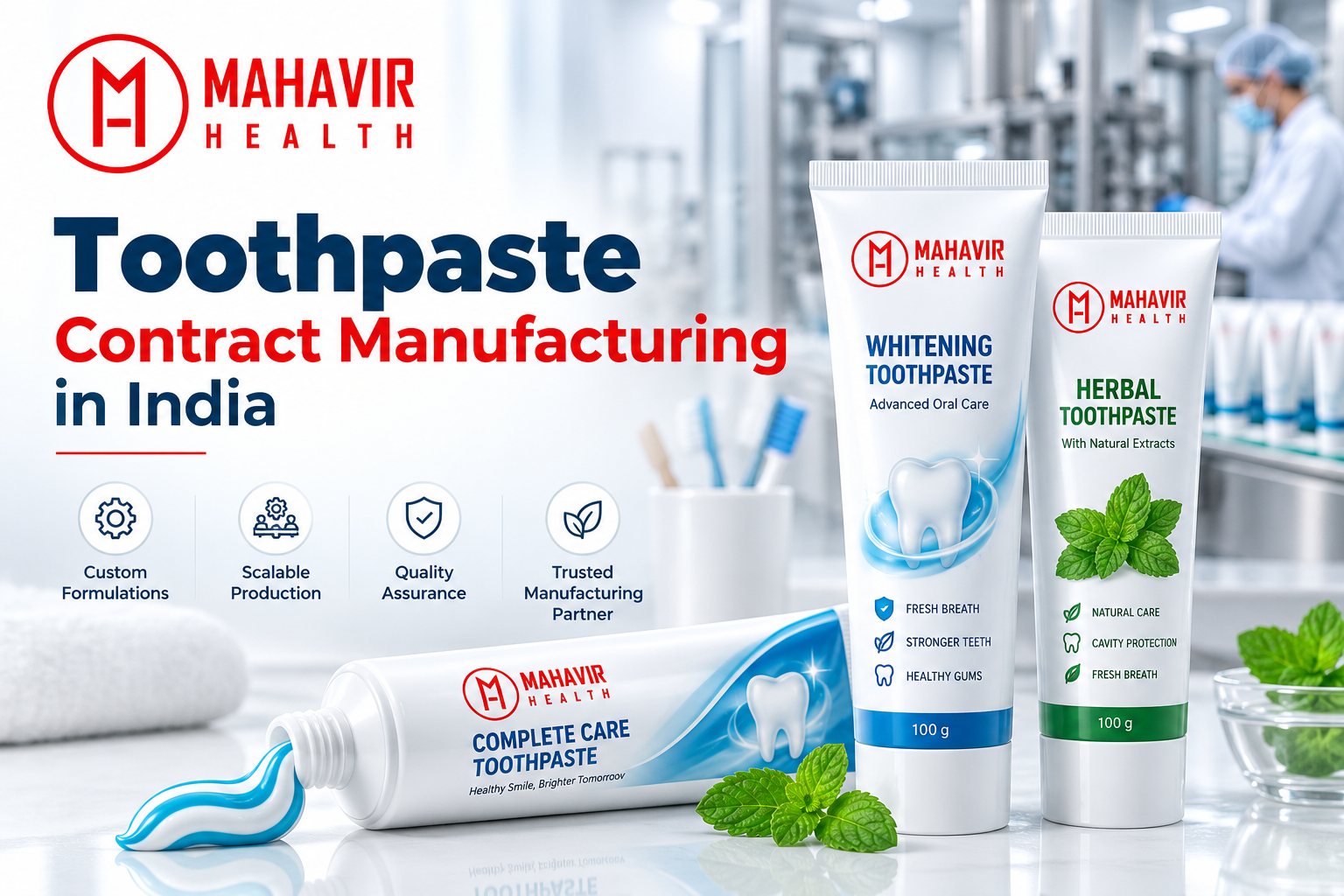
Toothpaste contract manufacturing in India means having a third-party manufacturing partner produce toothpaste for your brand against an agreed formula, specification and packaging brief. The project can cover sample development, ingredient sourcing, batch production, tube filling and packing. Mahavir Health can be contacted to discuss requirements; confirm the precise service scope before placing an order.
Two toothpastes can promise the same fresh brushing experience but behave very differently in production. The abrasive grade, water content, flavour system, viscosity and tube material influence how a product feels, stores and dispenses.
If you are planning Toothpaste Contract Manufacturing in India, do not start with price alone. Start with the consumer, permitted claims, benchmark sample and target pack. Those details make quotations comparable and help prevent expensive formula or artwork changes.
What You'll Learn:
- What contract toothpaste manufacturing includes and how private label differs
- A typical project workflow from brief to filled tubes
- How abrasive systems and fluoride compatibility influence design
- Product specifications and quality documents to request
- Toothpaste categories, consumer uses and package formats
- How to compare manufacturers, samples and quotations
- Common sourcing mistakes, short answers and buyer FAQs
What Is Toothpaste Contract Manufacturing?
Toothpaste contract manufacturing is outsourced toothpaste production under a brand owner’s agreed requirements. A project may use an existing base, an adapted private-label formula or a custom development brief, depending on the manufacturer’s scope and the agreement.
Common ingredients include cleaning abrasives such as calcium carbonate or hydrated silica; humectants such as sorbitol or glycerin; binders; surfactants; flavours; water; and, where appropriate, active ingredients. A fluoride toothpaste needs compatibility and available-fluoride assessment. Avoid inferring finished-product benefits from one ingredient alone.
Toothpaste Contract Manufacturing Process: Step by Step
A practical manufacturing brief follows these stages. The specific equipment, process sequence and testing plan depend on the approved formula and facility.
- Product Brief: Confirm audience, intended claims, flavour, format, fluoride approach, target cost, tube size and order estimate.
- Formula Review: Assess abrasive type, humectants, binders, surfactants, flavouring and any active ingredients for safety and compatibility.
- Sample Approval: Compare taste, smoothness, foam, appearance and dispensing with an agreed benchmark; retain an approved reference sample.
- Batch Planning: Confirm approved formula, ingredient controls, manufacturing steps and documented production instructions.
- Quality Assessment: Test agreed characteristics, including pH, viscosity, microbial quality, stability and active availability where relevant.
- Tube Filling & Packing: Verify fill weight, sealing, pack compatibility, batch coding and final artwork before dispatch.
Calcium Carbonate vs Hydrated Silica Toothpaste: Formulation Choices
| Buyer Check | Calcium Carbonate Formula | Hydrated Silica Formula |
|---|---|---|
| Abrasive Base | Calcium carbonate as the primary abrasive | Hydrated silica as the primary abrasive |
| Mouthfeel | Depends on particle size, dispersion and complete formula | Depends on silica grade and complete formula |
| Fluoride Compatibility | Review fluoride source carefully; sodium fluoride can interact with calcium carbonate | Compatibility options differ; test the complete formula |
| Abrasivity | Cannot be determined by mineral name alone; review finished-product testing | Cannot be determined by abrasive name alone; review finished-product testing |
| Purchasing Priority | Review grade, smoothness, cost and active compatibility | Review silica grade, rheology and active compatibility |
Key Toothpaste Product Specifications for Buyers
Ask for a written finished-product specification rather than “standard paste”. Numerical ranges and test methods should be approved for the actual formulation and market, not borrowed from another toothpaste.
- Ingredient Quality: Discuss intended oral-care suitability, supplier documentation, traceability and relevant impurity controls.
- Fineness & Texture: Specify smoothness and appropriate particle or dispersion checks to reduce gritty mouthfeel.
- Cleaning & Abrasivity: Consider appropriate finished-product evaluation; abrasive names alone do not define abrasivity.
- pH & Viscosity: Set formula-specific acceptance criteria that support stable filling and consumer dispensing.
- Active Compatibility: Where fluoride or another active is included, verify its compatibility and availability through appropriate testing.
- Microbial Quality & Stability: Agree on sampling, storage checks, separation, flavour retention and proposed shelf-life evidence.
- Packaging: Define net content, tube laminate or material, cap, seal integrity, cartons and printed artwork.
- Regulatory Requirements: Review applicable Indian requirements, including the relevant edition of IS 6356 where applicable, and destination-market rules. Do not infer certification from a standard reference.
Toothpaste Formats, Applications and Buyer Categories
Possible brand concepts include everyday family toothpaste, mint or other flavour-led pastes, gel formats, fluoride or fluoride-free formulas, and carefully substantiated sensitivity or whitening positioning. Travel-size and retail tubes serve different users and pricing needs; availability must be confirmed.
A distributor may prioritize pack economics and distribution shelf life while a D2C brand may focus on taste, repeat-use feel and visual identity. In both cases, the approved formula, artwork and acceptance criteria must match the commercial brief.
How to Choose a Toothpaste Contract Manufacturer in India
- Clarify the Commercial Model: Ask whether the project uses a stock formula, modified base or new formulation; confirm ownership and change-control terms.
- Request a Real Sample: Evaluate brushing feel, flavour, dispensing and storage behaviour before signing off.
- Review Documented Controls: Ask about ingredient traceability, test reports, batch records and release responsibilities.
- Check Tube Compatibility: Confirm that the intended tube and cap function with the approved paste across expected storage.
- Compare Equivalent Quotes: Match formula, net weight, tube specification, printing, cartons, order quantity and freight assumptions.
- Approve Artwork and Schedule: Define label review, sampling sign-off, printed-pack lead time and production milestones.
Common Mistakes When Sourcing Private Label Toothpaste
1. Treating an ingredient as proof of a product claim. Words such as herbal, sensitive, whitening or enamel care require review of the actual formula, evidence and applicable labelling rules.
2. Selecting an abrasive without compatibility review. For example, a calcium carbonate system may need a different fluoride strategy from some silica-based systems; available fluoride should be tested where relevant.
3. Approving flavour on the first brush only. Taste, aftertaste, foaming and mouthfeel can change with age or storage. Keep an approved reference sample and a documented review method.
4. Forgetting the tube. A good paste that hardens at the nozzle, leaks or separates in its final tube is still a poor finished product. Test the formula and pack together.
5. Comparing quotations with different assumptions. A plain tube and a printed laminate tube, or different fill weights and cartons, are not comparable unit-for-unit.
Planning a Toothpaste Manufacturing Project With Mahavir Health
Mahavir Health can be approached with toothpaste contract manufacturing enquiries, including a private label brief, proposed formula attributes, tube format and intended market. Discuss feasibility, available options, sampling and commercial terms directly instead of assuming every product type is already offered.
1. Define Your Toothpaste Concept
Define the intended users, target market, paste or gel format, flavour, fluoride preference and proposed claims. If you have a benchmark, specify what to reproduce in texture and taste—not just its colour.
2. Review Texture, Taste and Brushing Feel
Check smoothness, spreadability on a toothbrush, foam, aftertaste, dispensing and changes after repeated use. A sample can appear perfect on the first day and develop an unwanted dry plug at the nozzle.
3. Agree on Testing and Release Criteria
Agree on a suitable testing plan for appearance, pH, viscosity, fineness or abrasivity, microbial quality, stability and active-ingredient content where applicable. Ask who reviews and signs off results.
4. Confirm Tubes, Printing and Labelling
Choose tube material and size, cap, seal, coding, printing and outer carton while evaluating product compatibility. Confirm label declarations and claims for the intended sales market.
5. Request a Like-for-Like Quotation
Provide quantity by pack size, artwork readiness and delivery expectations. Request a milestone plan for sampling, approval, printed packaging and production scheduling.
Technical Perspective for a Toothpaste Development Brief
“For a toothpaste brief, agree on the brushing feel and the testing plan before fixing the tube artwork. A formula that feels right today still needs to remain consistent in its intended pack.” — Draft technical perspective for the Mahavir Health team to review and approve; not presented as a verified statement from an employee.
Sticky Buyer Q&A: Quick Answers Before You Request a Quote
What does a contract toothpaste manufacturer do?
Short answer: A contract manufacturer produces toothpaste to an approved brand specification and may support formula adaptation, tube filling and packaging as agreed.
Is private label the same as contract manufacturing?
Short answer: Not exactly. Private label often begins with an available formula; contract manufacturing can also cover customized formulations and processes.
Can a brand request fluoride-free toothpaste?
Short answer: It can be included in a project brief. Ingredient choices, intended claims and feasibility need review before a fluoride-free formulation is approved.
Can Mahavir Health discuss a toothpaste private label brief?
Short answer: Yes, contact Mahavir Health with your target market, formulation needs, pack format and planned quantity to discuss what is available.
What affects minimum order quantities?
Short answer: Formula requirements, raw-material availability, tube printing, cartons and planned batch size can all affect the minimum order quantity.
Which sample checks matter most?
Short answer: Check brushing feel, taste, viscosity, storage behavior and actual tube performance, alongside agreed quality tests.
Does fluoride choice affect toothpaste formulation?
Short answer: Yes. The fluoride source must be compatible with the abrasive system, and available fluoride must be assessed when fluoride is used.
What information should be in an enquiry?
Short answer: Include your audience, claims, preferred formula, flavour, tube size, branding, expected order quantity and target market.
Frequently Asked Questions
What is toothpaste contract manufacturing?
Toothpaste contract manufacturing is an arrangement in which a brand commissions a third-party facility to formulate or produce toothpaste to an agreed specification. Packaging, testing, ownership and release responsibilities should be defined in writing.
What is the difference between private label and contract manufacturing?
Private label commonly uses an existing or adapted product under a buyer’s brand. Contract manufacturing may involve a buyer-defined or jointly developed formula. Actual scope depends on the agreement.
Which toothpaste formulations can buyers discuss?
Common project briefs include fluoride or fluoride-free toothpaste, herbal-inspired flavours, gel or opaque paste, sensitivity-focused positioning and different abrasive systems. Ingredients, claims and available options require technical and regulatory review.
Can a toothpaste manufacturer make a fluoride toothpaste?
A fluoride toothpaste requires an appropriate fluoride source, compatibility testing, available-fluoride checks and compliant claims and labelling. Do not assume that every abrasive and fluoride combination will remain stable.
What quality tests should be considered for toothpaste?
Discuss appearance, pH, viscosity, fineness or abrasivity where relevant, microbial quality, stability, pack compatibility, fill weight and active-ingredient content where applicable. Set numerical acceptance criteria for the approved formula.
What is the MOQ for private label toothpaste in India?
MOQ depends on formula complexity, raw materials, tube size, printing, cartons and production scheduling. Ask for a project-specific MOQ after confirming the formulation and packaging brief.
How long does toothpaste contract manufacturing take?
Timing varies with sample approvals, raw-material availability, stability work, artwork review, printed tube lead times and planned batch size. Request a milestone-based timeline instead of assuming a fixed number of days.
What details are needed for a toothpaste manufacturing quotation?
Share the target market, intended consumer, formula or benchmark sample, flavour and fluoride preferences, claims, pack size, tube and carton requirements, expected quantity and documentation needs.
Conclusion
Choosing Toothpaste Contract Manufacturing in India is easier when you define the product before collecting prices. Formula compatibility, real-world brushing feel, test requirements, stable tube performance and compliant packaging are the details that separate a workable project from a repeated sampling cycle.
Planning a toothpaste brand or extending an oral care range? Share your concept, target market, tube size, formula preferences and approximate volume with Mahavir Health. Request a discussion about sampling, documentation, packaging and commercial feasibility.